Parts of the Guitar
Know your instrument inside and out
Why This Matters
Before you play a single note, it helps to know what you're holding. Understanding the parts of the guitar means you can follow any lesson, talk to other guitarists, and troubleshoot problems when something doesn't sound right. It only takes a few minutes and you'll reference this knowledge constantly.
Acoustic Guitar Anatomy
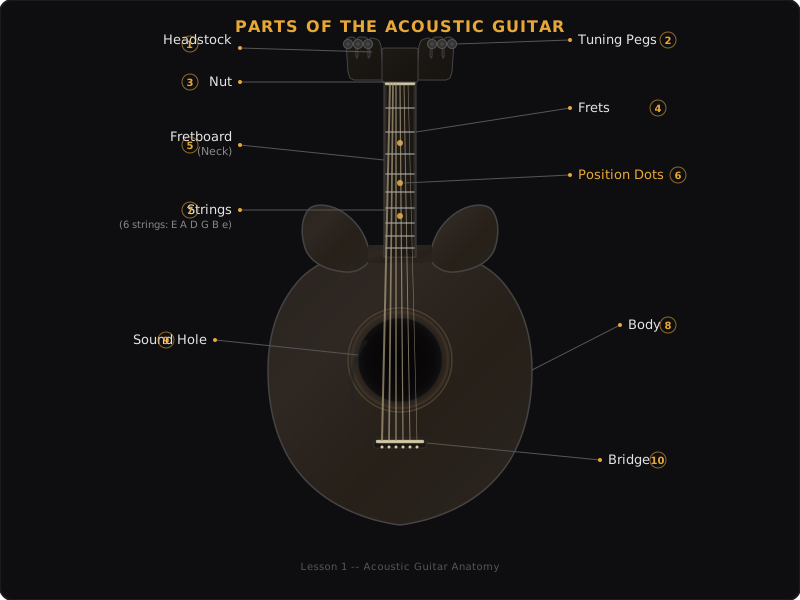
Starting from the top: the headstock sits at the very end of the neck. It holds the tuning pegs (also called machine heads or tuners) — you turn these to tighten or loosen each string to change its pitch.
Below the headstock is the nut — a small slotted piece of bone, plastic, or synthetic material that the strings pass over. It spaces the strings evenly and sets the height at the top end.
The neck is the long piece you wrap your hand around. On its front face is the fretboard (or fingerboard) — usually made of rosewood or maple. Embedded into the fretboard are thin metal strips called frets. When you press a string down behind a fret, you shorten the vibrating length of the string, raising the pitch.
The dots (or inlays) on the fretboard at frets 3, 5, 7, 9, 12, 15, 17, 19, and 21 are position markers — visual guides so you know where you are without counting every fret.
The large wooden body is where the sound is produced. On an acoustic guitar, the soundhole lets the vibrations from the strings resonate inside the hollow body. The flat face of the body is called the soundboard (or top). The bridge is glued to the soundboard — the strings are anchored here by bridge pins. The saddle sits in the bridge and is the other contact point for the strings (like the nut at the other end).
The strings run from the bridge, over the saddle, along the fretboard, over the nut, and up to the tuning pegs. Standard guitars have 6 strings, numbered 1 (thinnest, highest pitch) to 6 (thickest, lowest pitch).
Electric Guitar Differences
Electric guitars share most of the same parts but have some key differences. Instead of a hollow body with a soundhole, they have a solid body (usually). The sound comes from pickups — electromagnetic devices under the strings that convert string vibration into an electrical signal.
Most electric guitars have 2-3 pickups. A pickup selector switch lets you choose between them (neck pickup for warm tones, bridge pickup for bright/cutting tones, or combinations). Volume and tone knobs shape the sound before it leaves the guitar.
The bridge on an electric is often adjustable — you may see individual saddles that can be moved for intonation. Some guitars have a tremolo bar (or whammy bar) attached to the bridge for pitch-bending effects.
Instead of bridge pins, electric guitar strings typically thread through the bridge or body. The output jack is where you plug in your cable to connect to an amplifier.
String Names & Numbers
This is essential — memorise this now:
String 6 (thickest) = E (low E)
String 5 = A
String 4 = D
String 3 = G
String 2 = B
String 1 (thinnest) = E (high E)
A common mnemonic: Eddie Ate Dynamite, Good Bye Eddie
In guitar tab, the bottom line represents string 6 (low E) and the top line represents string 1 (high E). This catches many beginners out — it's upside down from what you might expect.
Tab Examples
The 6 open strings in tab
e---0--- B---0--- G---0--- D---0--- A---0--- E---0---
Tips
- Spend a minute looking at your own guitar and identifying every part mentioned
- The fret number is the space between the metal strips, not the strip itself
- String numbering goes thin to thick (1-6), which is bottom to top when you're holding the guitar
Practice Exercises
- Pick up your guitar and point to each part as you say its name aloud
- Pluck each string from 6 to 1, saying the string name as you go: E, A, D, G, B, E
- Look at where fret 5, 7, and 12 are using the dot markers