Changing Between Chords
The skill that separates beginners from players
Why This Is Hard (And How It Gets Easy)
Chord changes are the first real bottleneck every guitarist faces. Your fingers need to simultaneously lift off one shape and land on another, accurately, in time, without looking. It feels impossible at first.
The good news: this is 100% muscle memory. Your brain needs repetitions — hundreds of them — and then one day the change will just happen automatically. Everyone goes through this process. It typically takes 2-4 weeks of daily practice to get smooth chord changes.
Anchor Fingers
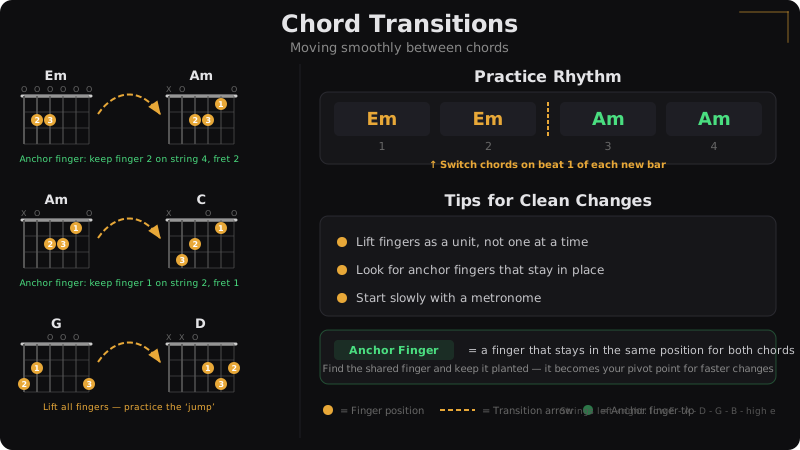
Look for fingers that stay in the same place (or close to it) between two chords. These are your anchor fingers — they stay down while the others move.
Common anchors:
- Am → C: Your index and middle fingers stay in almost the same area
- Em → Am: Middle finger stays on fret 2 (just shifts strings)
- C → Am: Ring finger lifts, index stays on fret 1 string 2
- G → D: No obvious anchor, but your hand stays in the same area of the neck
When you identify an anchor, keep that finger pressed down during the change. It gives your hand a reference point.
The One-Minute Change Exercise
This is the single most effective practice technique for chord changes:
1. Pick two chords (e.g., G and C)
2. Set a timer for 60 seconds
3. Alternate between the two chords as many times as you can
4. Count each successful change
5. Write down your score
6. Do this daily and track improvement
A "successful change" means all fingers land correctly — it doesn't need to be fast. Accuracy first. Most beginners start at 10-20 changes per minute and within a few weeks reach 40-60+.
Common Chord Progressions to Practise
Rather than random changes, practise common progressions that appear in real songs:
G — C — G — C (two-chord songs)
G — D — Em — C (the "pop progression" — used in hundreds of songs)
Am — G — C — Em (another hugely common pattern)
D — A — G — A (rock/country staple)
Em — Am — Em — Am (your first two chords, keep drilling them)
Strum each chord 4 times (one measure of 4/4) before changing. Use a metronome starting at a tempo where you can make every change cleanly — even if that's 40 BPM.
Troubleshooting Messy Changes
If your changes sound messy, isolate the problem:
Dead or buzzy notes after changing? Your fingers aren't landing precisely. Slow down and focus on accuracy.
Big gap of silence between chords? You're lifting your fingers too high and re-placing them one at a time. Try to move all fingers as a unit — lift and land together.
Accidentally hitting wrong strings? Your picking hand is compensating. Focus your strum on just the correct strings for each chord.
One particular change always fails? Isolate just that change and do the one-minute drill on it exclusively.
Tab Examples
G - D - Em - C progression
e--3--3--3--3----2--2--2--2----0--0--0--0----0--0--0--0-- B--0--0--0--0----3--3--3--3----0--0--0--0----1--1--1--1-- G--0--0--0--0----2--2--2--2----0--0--0--0----0--0--0--0-- D--0--0--0--0----0--0--0--0----2--2--2--2----2--2--2--2-- A--2--2--2--2-----------------2--2--2--2----3--3--3--3-- E--3--3--3--3-----------------0--0--0--0----------------
Am - G - C - Em progression
e--0--0--0--0----3--3--3--3----0--0--0--0----0--0--0--0-- B--1--1--1--1----0--0--0--0----1--1--1--1----0--0--0--0-- G--2--2--2--2----0--0--0--0----0--0--0--0----0--0--0--0-- D--2--2--2--2----0--0--0--0----2--2--2--2----2--2--2--2-- A--0--0--0--0----2--2--2--2----3--3--3--3----2--2--2--2-- E---------------3--3--3--3-----------------0--0--0--0--
Tips
- The one-minute change exercise is the single best thing you can do at this stage
- Track your daily scores — seeing improvement is incredibly motivating
- Start the metronome slower than you think you need — build speed gradually
- Don't look at your fingers if possible — train the muscle memory
Practice Exercises
- Do the one-minute change exercise for: G↔C, G↔D, D↔A, Am↔Em, C↔Am
- Record your scores and repeat tomorrow — aim for improvement, not perfection
- Play the G-D-Em-C progression on loop with a metronome at the fastest tempo you can manage cleanly
- Try the Am-G-C-Em progression — can you loop it without stopping?
- Challenge: play along to a song that uses G, C, D, and Em (there are many — search "4 chord songs")